

Guest author Mike Taylor shares insights from his book Think Like a Marketer, Train Like an L&D Pro (ATD Press), co-authored with Bianca Baumann.
You spent months building the course. The content is solid, the design looks good, the SMEs approved it, and the LMS is ready. You launch it.
Then… not much happens.
A few completions. Some polite clicks. Very little energy. Certainly not the kind of response you hoped for after all that work. That is a lousy feeling, and it points to a bigger problem.
Most of us know how to build learning. We learned how to analyze needs, write objectives, organize content, and launch programs. What we haven’t learned is how to get people interested before the thing goes live. We learned how to make the product, not how to create demand for it.
So when a course falls flat, we usually blame the course. Sometimes that’s fair. But often, the problem is simpler than that: nobody marketed it.
That is the blind spot. It is a marketing problem.
Publishing is not the finish line
Too many of us treat launch day like the end of the job. Build it, upload it, send the email, move on.
But that is not how this works anywhere else.
Nobody in the product world launches something new and just hopes people happen to notice. They build awareness first. They shape the message. They think about timing. They choose the right channels. They figure out how to make the value obvious before they ask anyone to act.
In other words, they run a campaign.
Meanwhile, training teams often build something useful, make it available, and then wonder why nobody seems very excited about it. That is like opening a restaurant with no sign, no menu in the window, and nobody outside telling people why they should come in—then acting surprised when the place is empty.
The launch is not the end of the work. It is one moment in the campaign. The real job starts before launch, builds through it, and continues well afterward.
“It’s live. Please complete it.” That is not a rollout. That is a notice. And notices get ignored.
The step most learning teams skip
Marketers understand something most of us often miss: people usually need a runway.
First, they need to know something exists. Then they need a reason to care. Only then are they ready to act.
A lot of course rollouts skip straight to the ask. The message is basically, “It’s live. Please complete it.” That is not a rollout. That is a notice. And notices get ignored.
Awareness comes first. People need to know the course exists and why it matters to them. Consideration comes next. That is where you build interest, give them a preview, and make the payoff obvious. The actual launch is the conversion moment, but by then, they should already be leaning in a little.
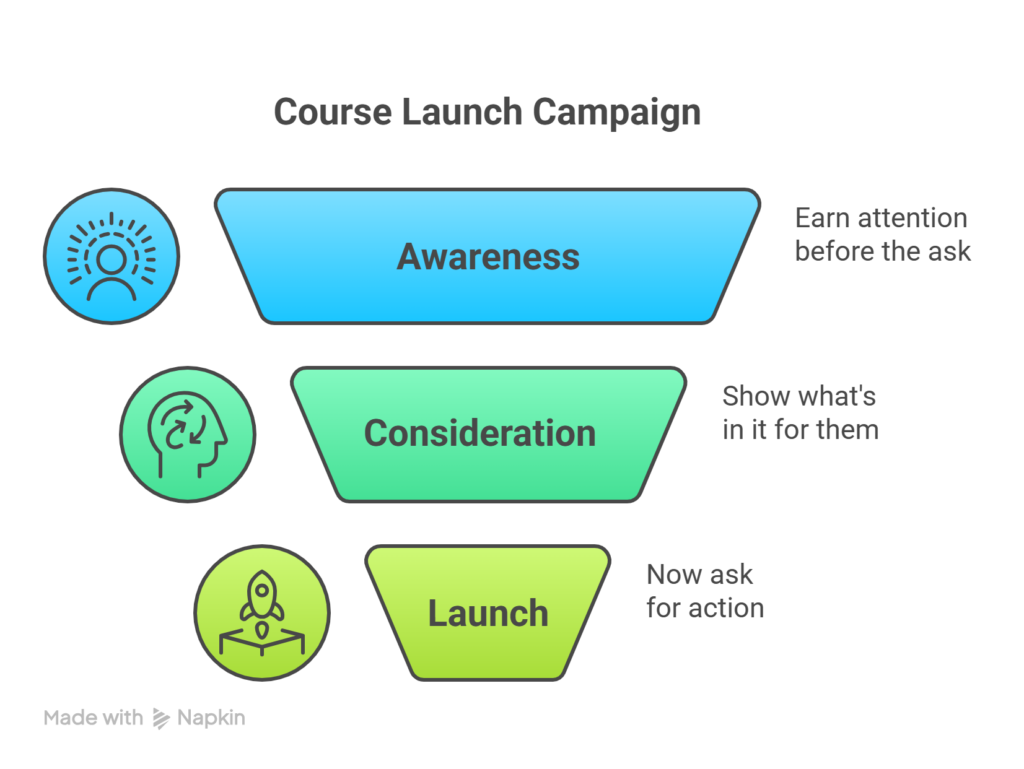
If you skip those first two steps, you are asking people to care on command. Good luck with that.
And yes, this applies even to required training. Mandatory doesn’t mean meaningful. You can force completion. You cannot force attention. If people show up checked out, you may get the metric, but you probably won’t see the behavior change.
That is why promotion matters. Not because you need to get louder, but because attention still has to be earned.
If people show up checked out, you may get the metric, but you probably won’t see the behavior change.
Three moves that make this better
1. Choose channels on purpose
“We’ll send an email” is not a strategy. It is a habit.
The real question is where your audience already pays attention. For some groups, email matters. For others, manager communication carries more weight. Sometimes team meetings help. Sometimes Slack helps. Sometimes the intranet is useful for visibility, but not much else.
Different channels do different jobs. Email can make the ask. Managers can add credibility. Team meetings can normalize it. Intranet posts can reinforce awareness in the background. The point is not to blast the same message everywhere. The point is to use a few channels deliberately.
That is a strategy.
2. Build some runway
One launch email is not a campaign. It is an announcement, and announcements are weak on their own.
A better rollout has a sequence. Before launch, surface the problem and make people feel the friction. At launch, make the value clear. What is this? Who is it for? What will it help me do better? After launch, keep it alive with reminders, manager nudges, or a quick story from someone who found it useful.
This isn’t complicated. But it is different from the usual send-it-once-and-hope approach.
Hope is not a strategy.
3. Stop writing like an internal memo
This is where a lot of learning promotion dies. The copy is flat, vague, corporate, and safe in all the wrong ways.
“Leadership Development Program now available in the LMS” is technically clear. It is also incredibly easy to scroll past.
Good copy does more than announce. It makes the value clear fast. It feels specific, human, and useful. It sounds like help, not housekeeping.
Do not write for a department. Write for a person. Do not lead with abstractions. Lead with something concrete. Do not promise vague improvement. Show people what gets easier, better, faster, safer, or less painful.
So instead of saying, “Improve your communication skills,” say, “Walk into your next tough conversation with a simple three-step plan.”
Instead of saying, “New escalation training is now available,” say, “Still not sure when to escalate an issue? This will clear that up in 15 minutes.”
That is better because it respects how people actually decide what deserves their attention.
Before your next launch
Yes, build the course. Make it strong. Make it useful. Make it worth people’s time.
But don’t stop there. Build the campaign too.
Think about the channels. Plan the sequence. Write the message like attention is something you have to earn, not something you automatically get just because the course exists. Your audience is dealing with the same thing the rest of us are: too much noise, too little time, and more competing demands than anyone can keep up with.
Mandatory training does not change that. A smarter rollout can.
So before your next course goes live, don’t just ask whether the content is ready. Ask whether you have given anyone a reason to care.
Guest Author

Mike Taylor is an author, speaker, and faculty member in the Graduate Instructional Design and Performance Technology program at Franklin University. He co-authored Think Like a Marketer, Train Like an L&D Pro (ATD Press) with Bianca Baumann. Mike writes about the intersection of marketing and workplace learning at trainlikeamarketer.com and publishes the Friday Finds newsletter. When he’s not geeking out about attention triggers, he’s probably planning his next travel adventure.